Anatomy of a New GPS Protocol: The TEXT-Prefix Messages
On December 13, 2023, GPS PRN 27 broadcast a single Subframe 4, Page 17 observation that was different from anything in the preceding 16 years of data. The first four bytes were 0x54455854 — ASCII for “TEXT”. Everything before that had been high-entropy binary. This is the story of what we know about those messages, what the byte-level structure reveals, and what questions remain open.
The TEXT-prefix corpus
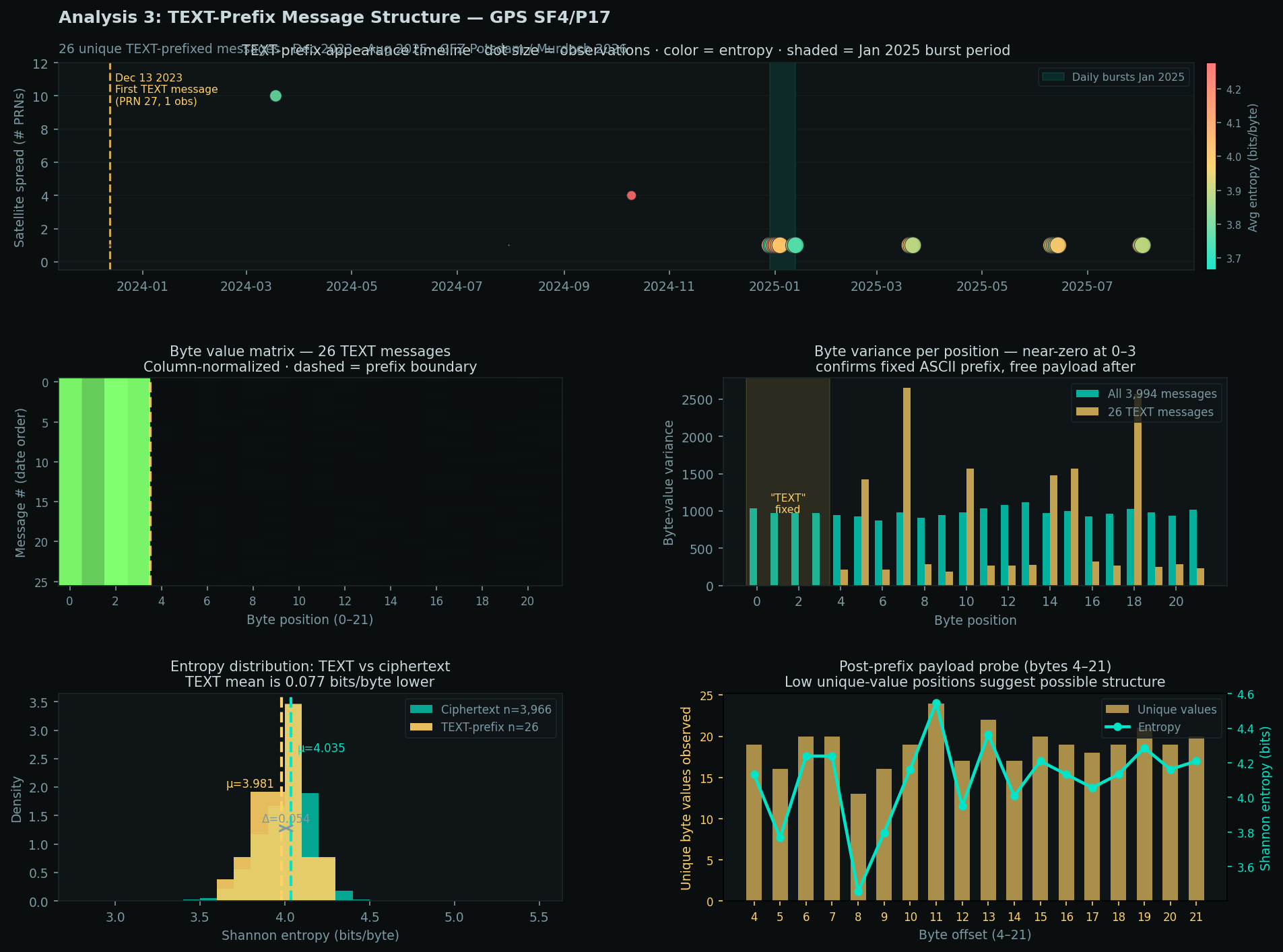
As of January 2026, the public dataset contains 26 unique TEXT-prefixed payloads spanning December 2023 through August 2025. They appear sporadically at first — one observation in December 2023, one in March 2024 on 10 satellites — then settle into a daily rotation pattern visible in January 2025, where a new TEXT message appears every day from December 29 through January 13. A similar daily burst appears in March 2025 and again in June 2025.
What the structure shows
The variance analysis is the most structurally informative panel. Bytes 0–3 have near-zero variance across all 26 messages — they are always exactly 0x54455854 (“TEXT”). After the prefix, bytes 4–21 are free to vary, and they do. The post-prefix entropy probe shows no obvious low-entropy positions in the 18-byte payload, which rules out a simple counter or sequence number embedded in a fixed location.
The entropy difference between TEXT messages and the standard ciphertext is measurable but small: TEXT messages average 3.963 bits/byte versus 4.040 bits/byte for ciphertext — a delta of 0.077 bits/byte. This is statistically significant given the corpus size but operationally modest. The lower entropy in TEXT messages is consistent with the four-byte ASCII prefix dragging down the per-message average — those bytes contribute exactly 0 bits of entropy since they never vary.
The satellite spread pattern
The most striking observation in the timeline is the March 18, 2024 event: a single TEXT message appeared on 10 different satellites simultaneously, with 61 total observations. Every other TEXT message in the dataset appears on either 1 or 4 satellites. A 10-satellite simultaneous broadcast is an outlier that looks like a test or a broadcast intended to reach the maximum number of receivers. The January 2025 burst period, by contrast, shows a single satellite (PRN 1) carrying a new TEXT message every day — consistent with a focused channel test or a single receiver being targeted.
What this could be
Murdoch’s paper notes the TEXT prefix as a new format without fully characterizing it. A few hypotheses consistent with the data: a human-readable metadata field prepended to identify the message type; a protocol version or capability advertisement for receivers that understand the new format; or a transitional format that precedes a broader rollout of a new OTAD protocol variant. The daily burst pattern in January 2025 — one new TEXT message per day, same satellite, same observation count — is the most constrained data in the set and the best candidate for further analysis when more data becomes available.
What the data does not support is the interpretation that TEXT messages contain human-readable content after the prefix. The 18 post-prefix bytes have entropy consistent with encrypted or encoded data, not cleartext. The “TEXT” label appears to be a type tag, not a content description.
Capturing it yourself
An RTL-SDR Blog V3 can receive GPS L1 at 1575.42 MHz. Paired with a GPS-band LNA (Uputronics or equivalent) and GNSS-SDR, you can capture raw navigation message bits and extract Subframe 4 Page 17 in real time. The analysis code used for this series is available on GitHub alongside Murdoch’s full dataset. The GFZ ground station data is updated on a rolling basis, so the TEXT-prefix corpus will continue to grow — the January 2025 burst alone represents 15 new data points that did not exist when Murdoch’s initial analysis was published.
Dataset: GFZ Potsdam GNSS navigation-bit archive via Murdoch (2026), DOI 10.5281/zenodo.20073222. All analysis is traffic analysis only — no decryption attempted or possible.